Hello all,
I am trying to create an inflation simulation in NGSolve by minimizing the potential energy functional which is calculated by the stresses on the boundary - the work done by inflation, i.e. the functional and it’s derivative are given by
VEC = VectorH1(mesh, order=2, dim=mesh.dim)

p_cf = CoefficientFunction(p)
F    = Id(mesh.dim) + Grad(u)

F_bnd = Id(mesh.dim) + Grad(u).Trace()

W    = neo_hookean_energy_nonneg(F_bnd, mu, lmbda)

E_bnd = W*ds
E_vol = -p_cf*dx


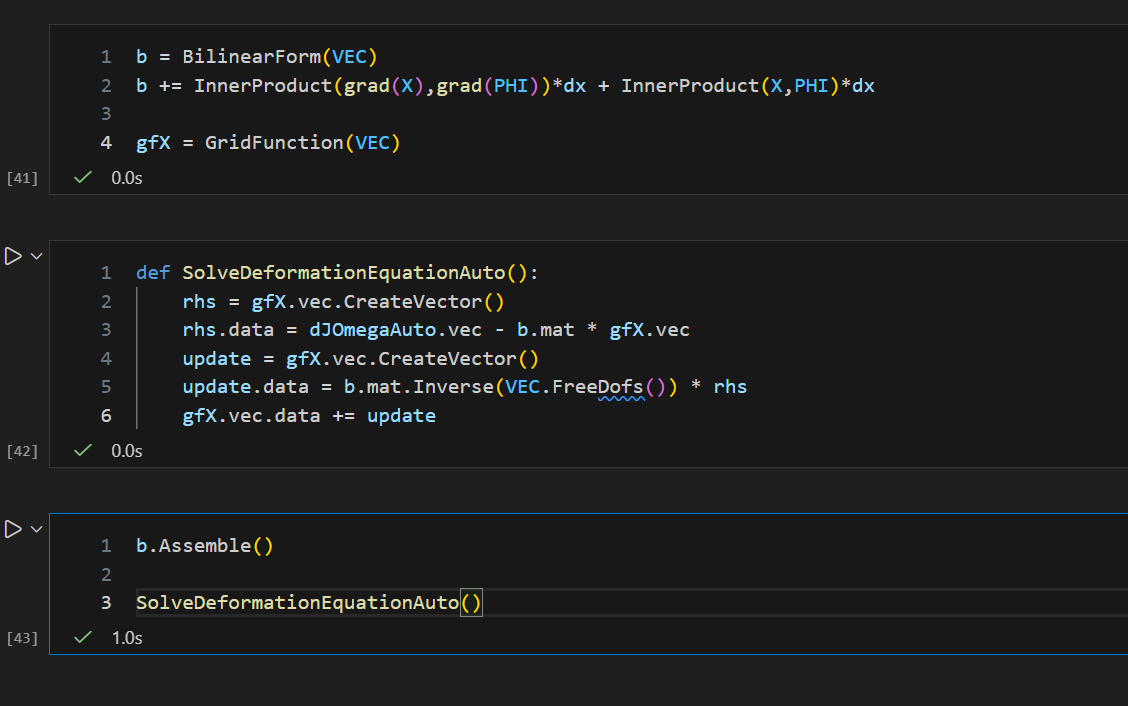
S_bnd = E_bnd.DiffShape(X)
S_vol = E_vol.DiffShape(X)

S = S_bnd + S_vol
dJOmegaAuto = LinearForm(VEC)
dJOmegaAuto += S
This works without any errors.
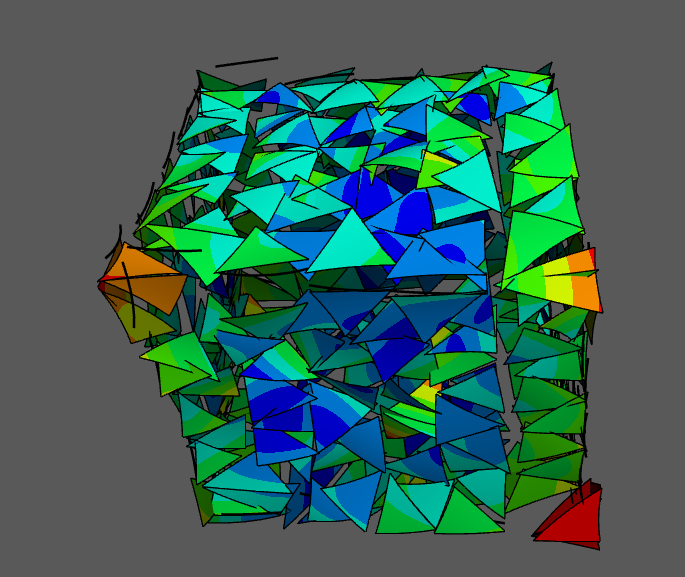
However, when I try using this to compute the deformation on my test cube, I see ‘discontinuities’ in my mesh:
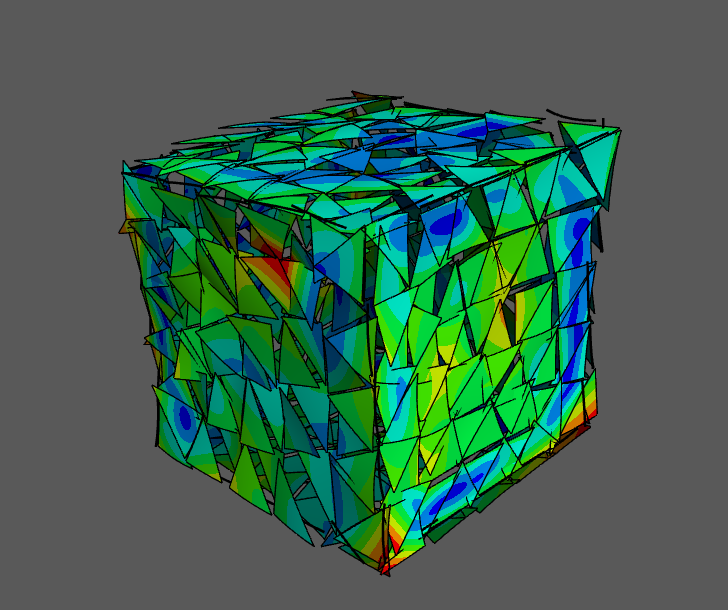
For the optimization, I am using the following code:
from math import isfinite
Qk = 1.0                     # Zhang–Hager running weights
Ck = None                    # Zhang–Hager reference value (set on first call)

def zh_ls(Jold, g_vec, direction_gf, phi_gf, *, descent=True,
          c1=1e-3, shrink=0.5, max_backtracks=30, move_frac=0.3,
          alpha_hint=None, theta=0.85):
    """
    Zhang-Hager non-monotone Armijo line search.
    """

    global Qk, Ck

    # --- boundary move-limit initial α ---
    bm = float(Integrate(1, mesh, BND))
    if bm <= 0:
        return 0.0, Jold
    rms_b = (Integrate(InnerProduct(direction_gf, direction_gf), mesh, BND)/bm + 1e-30)**0.5
    if rms_b == 0.0:
        return 0.0, Jold

    alpha_ml = move_frac * hmax / rms_b
    alpha = alpha_ml if alpha_hint is None else min(alpha_hint, alpha_ml)

    # set reference Ck on first call
    if Ck is None:
        Ck = Jold

    # directional derivative at 0
    gTd = float(InnerProduct(g_vec, direction_gf.vec))
    if not descent:
        gTd = -gTd   # reuse same inequality by flipping sign convention below

    # --- snapshot & trial ---
    phi_old = phi_gf.vec.CreateVector(); phi_old.data = phi_gf.vec
    trial   = phi_gf.vec.CreateVector()

    def ok(Jnew, a):
        rhs = Ck + c1 * a * ( -gTd if not descent else gTd )
        return Jnew <= rhs

    for _ in range(max_backtracks):
        trial.data = phi_old
        trial.data += alpha * direction_gf.vec

        # commit trial deformation
        phi_gf.vec.data = trial
        mesh.SetDeformation(phi_gf)

        # u := trial deformation for surface energy
        gfu.vec.data = trial
        Jnew = float(Integrate(energy_functional_nonneg(gfu), mesh))
        if not isfinite(Jnew):
            alpha *= shrink
            continue

        if ok(Jnew, alpha):
            # update Zhang-Hager reference
            Qk1 = theta*Qk + 1.0
            Ck  = (theta*Qk*Ck + Jnew) / Qk1
            Qk  = Qk1
            return alpha, Jnew

        alpha *= shrink

    # revert on failure
    phi_gf.vec.data = phi_old
    mesh.SetDeformation(phi_gf)
    gfu.vec.data = phi_old
    return 0.0, Jold
The output rendered is generated by
fes = VectorH1(mesh, order=2, dirichlet=".*")
gfu = GridFunction(fes)
scene_u = Draw (gfu, mesh, "state")
and then updated as in the Zhang-Hager code snippet. Where could this error originate from? I am thinking that this might be related to the fact that I am using two different H1 spaces (VEC for the shape derivative and fes in the rendering snippet), but I wanted to make sure that I am not missing any crucial information regarding the inner workings of NGsolve (i.e. a rendering bug or some flag that I forgot to set).
Kind regards